
CHANGING PERSPECTIVES ON EDUCATION THROUGH ERASMUS+
Your Next Erasmus+ Project Could Start Under an Olive Tree
From Jaén to Europe: a ready-to-adapt VET concept for skills, sustainability, innovation and rural resilience.
🎧 Introduction: approximately 70 seconds · Hover or tap underlined terms for Spanish.THE PROJECT HIDING IN PLAIN SIGHT
Europe does not need another study visit. It needs shared solutions to shared rural challenges.
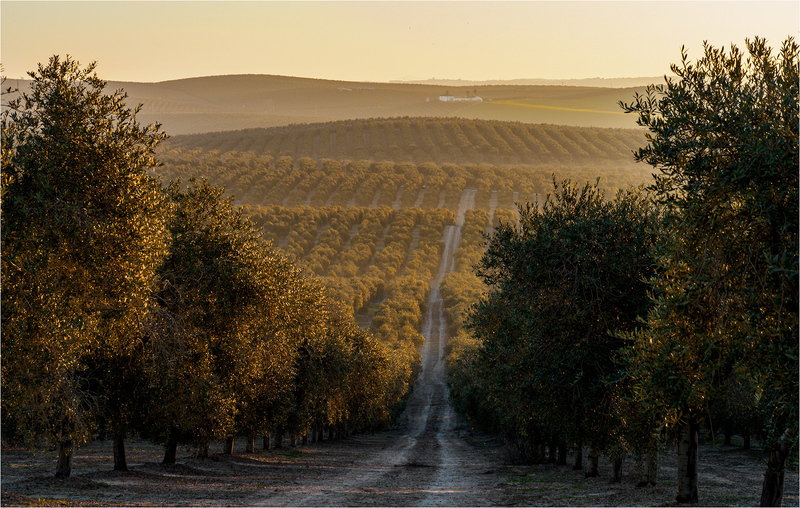
Stand beneath an olive tree in Jaén and you are surrounded by far more than agriculture. You are inside a European learning ecosystem: growers, cooperatives, mills, laboratories, machinery firms, exporters, tourism organisations, researchers and vocational schools.
The sector faces questions that no region should answer alone. How can water, energy and by-products be managed more intelligently? How can digital tools strengthen traceability without excluding smaller operators? How can VET respond to automation, climate pressure, quality requirements and changing rural employment?
An Erasmus+ project can turn those questions into learning. Not by organising attractive visits, but by enabling learners, teachers and companies to compare systems, test methods and produce resources that others can use.
01 · BEGIN WITH THE NEED
“Olive oil” is a theme. These are project problems.
Climate adaptation
Heat, drought, soil health and variable harvest conditions require new competences and locally appropriate responses.
Resource efficiency
Water, energy and materials must be understood across the chain—not reduced to slogans.
Digital capability
Sensors, data, automation and traceability create value only when people can interpret and govern them.
Skills mismatch
VET provision must keep pace with technical, linguistic and transversal workplace requirements.
Unequal participation
Rural location, disability, income, language and confidence can limit access to mobility and advanced learning.
Rural resilience
Territories need viable careers, new services and reasons for talented young people to remain or return.
02 · PROJECT CANVAS
OLIVE LEARN EUROPE
Open Learning for Innovation, Vocational Excellence and European rural resilience
Overall aim
Enable VET learners and educators to co-design, test and transfer sustainable, digital and inclusive learning solutions for the olive-oil value chain.
Primary audiences
VET learners, teachers, company mentors and recent graduates, with deliberate participation of people facing barriers.
European value
Compare cultivars, climates, processing systems, VET structures, SME models, visitor experiences and regional strategies.
Core competences
Green, digital, technical, linguistic, entrepreneurial, intercultural and evidence-based decision-making.
Flagship outputs
Open challenge bank, digital process map, mobility toolkit, circularity cases, mentor guide and replication canvas.
Intended change
More relevant curricula, stronger school–business cooperation, better-supported mobility and tested resources entering routine practice.
Do not ask, “Where would we like to travel?” Ask, “Where is the competence we need—and what will learners be able to do afterwards?”
03 · BUILD A VALUE-CHAIN PARTNERSHIP
Every partner should own a problem, a task and a result.
VET provider
Curriculum, learner preparation, assessment, recognition and pedagogical transfer.
Evidence of value:resources enter real teaching programmes.Mill or cooperative
Authentic production challenges, mentors, workplace learning and technical validation.
Evidence of value:staff test and comment on learner outputs.Research / technology centre
Methods, technical rigour, data interpretation and innovation pathways.
Evidence of value:complex knowledge becomes teachable practice.Agri-tech SME
Sensors, data, traceability, automation and user-centred digital design.
Evidence of value:learners solve a defined digital problem.Tourism / rural actor
Heritage, accessibility, visitor experience, local enterprise and dissemination.
Evidence of value:a service is tested with real audiences.Inclusion specialist
Barrier analysis, accessible materials, mobility support and participation monitoring.
Evidence of value:design choices change before activities begin.The geography is illustrative. Select each country and organisation because it supplies a competence the needs analysis demands.
04 · SIX WORK PACKAGES
A 14-month pathway from evidence to uptake
WP1 Evidence, baseline and co-design M1–M2
Map skill gaps with learners, staff and employers; establish baselines; identify barriers; agree ethics, quality, communication and decision-making.
Outputs: needs report, indicator framework, accessibility and quality protocols.WP2 Smart Mill Learning Lab M2–M6
Co-create learning scenarios around process data, traceability, quality incidents, maintenance, safety and informed human decision-making.
Outputs: six company-backed challenges and reusable simulation materials.WP3 Circularity Without Greenwashing M3–M7
Compare by-product pathways, resource trade-offs and evidence standards. Learners evaluate feasibility instead of repeating generic claims.
Outputs: case bank, decision rubric and evidence checklist.WP4 Inclusive European Mobility M5–M10
Prepare linguistic, technical and intercultural competence; implement mentored workplace tasks; capture learning; provide individual accessibility support.
Outputs: mobility toolkit, mentor guide and competence portfolios.WP5 Rural Innovation Sprint M9–M12
International teams prototype a service or process improvement: accessible oleotourism, data dashboard, by-product solution or export communication tool.
Outputs: tested prototypes and stakeholder evaluation.WP6 Transfer, Recognition and Uptake M11–M14
Integrate results into teaching, train colleagues, publish accessible open resources and support external VET providers to adapt the model.
Outputs: open course, implementation plans and replication canvas.05 · AGRICULTURAL TIME IS PROJECT TIME
Synchronise learning with the olive calendar.
06 · INCLUSION THAT CHANGES THE DESIGN
Opportunity is not inclusive if only the easiest participants can access it.
Participation
Use transparent selection, outreach and preparatory pathways. Monitor who applies, who is selected and who completes.
Accessibility
Review transport, accommodation, workplaces, digital resources, communication, fatigue and sensory or mobility needs.
Support
Define mentors, buddies, emergency contacts, reasonable adjustments, wellbeing check-ins and contingency plans.
Recognition
Value technical progress, language, confidence, autonomy and contribution—not only confident public performance.
Budget is part of inclusion. If support is essential to participation, it must appear in planning, responsibilities, timing and the eligible cost logic of the applicable action.
07 · DIGITAL WITH A PURPOSE
Never begin with the tool.
Begin with a decision learners or companies need to make. Then determine which data, device or interface can support it. Digital activities should address accessibility, privacy, data quality, staff capacity and long-term ownership.

08 · INTERACTIVE CONCEPT BUILDER
Generate a disciplined 60-second project pitch
This generator supports discussion. It cannot replace partner consultation, baseline evidence or action-specific application requirements.
09 · MEASURE WHAT CHANGES
Outputs are produced. Outcomes are demonstrated.
≥20% improvement in a common performance task.
EvidenceBaseline/final rubric + learner portfolio.
≥80% of tested challenges validated as usable or adaptable.
EvidenceStructured mentor assessment.
Reduced application, participation or completion gaps.
EvidenceDisaggregated data + participant voice.
At least four modules integrated into routine provision.
EvidenceCurriculum plans + implementation logs.
Three non-partner VET providers adapt one resource.
EvidenceAdaptation plans + follow-up.
Two cooperation activities continue after funding.
EvidenceNamed owner, timeline and commitment.
All targets are examples. Final values must follow the baseline, project scale, duration and partners’ real capacity.
10 · PROJECT READINESS AUDIT
Is your idea rooted deeply enough?
Start beneath the surface: document the need.
11 · FAILURE-PROOF THE CONCEPT
Six seductive mistakes
- “Olive oil is important here.” Importance is context, not a needs analysis.
- Technology theatre. A sensor demonstration is not digital competence unless learners interpret and act on data.
- Green vocabulary without baselines. “Sustainable” must be connected to indicators, boundaries and trade-offs.
- Mobility as the main result. Travel is a method; competence and organisational change are results.
- Token inclusion. Inviting someone is not the same as removing the barriers to participation.
- Dissemination without uptake. Views and attendees matter less than documented use, adaptation and ownership.
CONNECT PROJECT DESIGN TO CLASSROOM LEARNING
The four-part agrifood cluster is complete.
Vineyard Passport
Technical viticulture and professional English.
Open resource ↗From Vineyard to Europe
Wine English, VET careers and mobility.
Add the published URL when available.From Olive Grove to Europe
C1 English, EVOO technology, quality and export.
Add the published URL when available.Start Under an Olive Tree
The Erasmus+ concept you are reading now.
Project design and European cooperation.VERIFY BEFORE YOU APPLY
Authoritative starting points
- Current Erasmus+ Programme Guide
- Erasmus+ opportunities for VET organisations
- Mobility projects for VET learners and staff
- Erasmus+ Project Results Platform
- SEPIE — Spanish National Agency
- CITOLIVA — Olive Oil Technology Centre
- University of Jaén
- Agri-food Digitalisation Observatory
Editorial review: September 2026. Calls, eligibility, priorities, rates, deadlines and documentation can change. Use the applicable call, current Programme Guide and National Agency guidance.
ROOTED LOCALLY · DESIGNED EUROPEANLY · MEASURED HONESTLY
The next European project may already be growing outside your window.
Begin with evidence. Invite the right people. Design the learning. Then let mobility take it further.
Visit the blog and followWritten by Manuel Molina · Changing Perspectives on Education through Erasmus+
Comentarios
Publicar un comentario